



September 21, 2026

Learning Organization: Your Company’s Survival Depends on It

Author

Date

September 21, 2026

Share

Change is rapidly accelerating and becoming more chaotic.  Leadership agility is a competency every leader should learn.


The main purpose of this blog is to say that will not be enough for your company. If you want your company to survive without a premature death, then you need to build a learning organization,


A former colleague of mine at Royal/Dutch Shell, Arie de Geus wrote a book called The Living Company Habits for survival in a turbulent business environment.


He contended through his work that a central attribute of companies with long lives was a sensitivity to the environment with the ability to learn and adapt. De Gues highlighted several other attributes that contribute to a long company life, which will be discussed later.

What are some of the attributes of a learning organization? 


My tutelage on learning organizations came from a consultant Shell used, Peter Senge, who wrote The Fifth Discipline: The Art & Practice of The Learning Organization.


Senge delves into the notion of a learning disability. A key point I want to make is that you will naturally develop this learning disability.

The Proverbial S Curve

In my opinion, living systems tend to follow the proverbial S shape curve because of their learning ability.


 A newborn entity has little knowledge and focuses outward through a structuring process of how things work or should work. 


Once a foundation is set, the structuring process accelerates, and rapid learning growth occurs.

As time progresses, this learning growth slows as the focus shifts inward towards maintaining all this structure of perceptions, beliefs, values, processes, procedures, mental models and so forth. 


As Senge aptly points out in his book, “Today’s problems come from yesterday’s ‘solutions’” (page 57)


Eventually, the growth and learning plateaus, that is, unless there are interventions.

As a “living” entity, what can a company do to become a learning organization to combat the natural inertia from the past?.

Learning Structures

Your company must specifically build in learning structures. De Guess identified two more habits worth noting.


One is tolerance both within and outside the entity itself. Another way of thinking about this habit is valuing diversity of thoughts.


It’s more than inclusion. The organization needs to seek out understanding of these diverse views. In this respect, the diverse views involve differences from the current modus operandi of the company.


Understanding does not imply immediate change.


Many diverse views will not make sense for the company to pursue. But an arbitrary discounting of such ideas becomes deadly in this rapidly changing world.


Secondly, de Guess describes the habit of building cohesion and identity. 


This may sound contradictory to diversity. Quite the contrary, the persona must be built around this burning desire to learn from one another.


As Senge describes, your people need to be lifelong learners.


Thus, the concept of a learning organization needs to be built into the stated company values.


The organization needs to celebrate renewal efforts and achievements.

Learning must become fundamental to the culture..

Systems Thinking

Peter Senge advocates that systems thinking is a key discipline of learning organizations. I clearly agree.


When I received my master’s degree in management science, systems thinking was a cornerstone, but you don’t hear as much about it today.


It is all about seeing the big picture in a wholistic way looking at the various relationships and factors that bring about your outcomes.


As entities build structures on how things work, there become a lot of parts and sub processes which bogs down learning as the focus is on the trees and not the forest.


This is not to say that continuous improvement programs should be scrapped. They are one of the “structures” that should be imbedded in a learning organization.


The major shifts and transformations occur at the wholistic system level of a company.


Learning organizations need to imbed vehicles to periodically look at the big picture or when alarms are sounded from external sensing systems.


System audits should ask from the internal side, “What ground-breaking change could we do differently that would have a magnitude improvement on our outcomes?”


From an external perspective, system audits should look at competitors but also pace setting companies who have made major transformations.


Obviously, scanning for new technologies and how they could redesign the way your company operates is another part of a systems audit.


Then there are also major environmental events like COVID 19 that should trigger a systems audit..

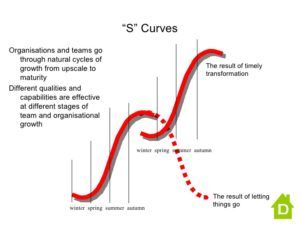
Layering on a new S Shaped Curve

Graph from In Blogs : What we Do. by Cole Scott Group Nov. 16, 2016

Another Shell consultant back in the 1990s was Ichak Adizes who taught us about corporate lifecycles. He authored a book called Corporate Lifecycles: How and Why Corporations Die and What to Do About It.


Adizes described to us the growing and aging process a company goes through and outlined some characteristics of growing companies versus aging companies.


A couple of these characteristics really struck me.


In a growing company, “Personal success stems from taking risks” whereas in an aging company “Personal success stems from avoiding risk.” (page 87)


In a growing company, “Everything is permitted, unless expressly forbidden” whereas in an aging company “Everything is forbidden, unless expressly permitted.” (page 87)


Relating to this last point, he talked about the importance of culture with the two dimensions of flexibility and control.


At a company’s prime, flexibility and controllability are balanced. As controllability becomes more dominant, the aging process eventually leads to death.


My big takeaway was a learning culture can expand the shape and timing of a company’s S curve through maintaining flexibility. 


Today, that is called agility. It needs to be part of the organization’s fabric.


Beyond that, there are times in the life cycle when systems thinking can bring about a major transformation in the business model.


In essence, the company layers on a new S curve as shown in graph above. The key is to jump onto the next S wave before it is too late.


When this structural competency is developed in an organization, the life cycle can be extensively extended by having multiple layers of S curves..

Adding Learners to your Company

The last “learning structure” that I want to recommend is consciously adding learners to your company.


Bringing diversity of thought, perspective, and backgrounds as previously discussed is important for your hiring process and something you have likely already included.


My suggestion is that you carefully examine potential hires’ willingness to be tolerant of other points of view along with a strong learning desire.


You can’t build a learning culture with a preponderance of people who aren’t learners.


Many new hires will come from the Millennials (those born between the early 1980s and mid-1990s) plus some of Gen Z (those born between the mid-1990s and 2010).

Millennials Like to Learn

Fortunately, the Millennials are generally curious with an eagerness to develop new skills and learn.


They are also multi-taskers.


I remember one day when I heard a lot of noise from my Millennial daughter’s bedroom. She had told me she had a lot of homework, so I wanted to check up on the commotion. It was an incredible sight.


She was sitting with a laptop in her lap but typing on her desktop while watching TV with music blaring away.


When I asked her what she was doing, she answered my homework.


Beyond that, Millennials tend to excel with out of the box thinking and creative problem solving. This will be an important competency skill set in developing the next S shape curve for your company.


Many have high expectations of your company and not afraid to express their views which is what you want in a learning organization.

Gen Z Diversity

Generation Z also has some positive characteristics.


They are entrepreneurial and not surprising all about technology.


This generation has grown up in a rapidly changing world, so they are receptive to change.

You will need that attitude in your learning organization.


Fortunately, diversity of all forms is natural to them and generally not a divisive issue.

Don’t Forget Baby Boomers

Lastly, you may want to consider a baby boomer (those born between 1946 and 1964) as a mentor to help you build your learning organization.


They have many positive characteristics too including resourcefulness and being mentally focused.


As this generation deals with their Millennial sons and daughter and their grandchildren of the next Generation Alpha, their views of change continue to morph.


Now that they are in a mentor position in their careers, baby boomers can bring a lot of unbiased wisdom having seen it all evolve.

Summing it Up

The most basic need of a living system is to survive. 


Have you built structures that will foster a learning organization in your company?


Take some advice from a baby boomer—do so now before it’s too late.


Your company’s survival depends on it.

Six white pawns with a taller central piece on a gray surface, symbolizing teamwork or leadership
September 21, 2026
Confusing Contrast
Paper figures on arrows, one person stepping upward on the top arrow against a beige background
September 21, 2026
Model of Technology Change
White figure standing on upward arrows, looking ahead with telescope, symbolizing growth and direction
September 10, 2026
Leadership does not have a simple formula for every situation. A lot of the leadership theory comes from academicians studying a formulation of their leadership model from observing the real world. They test the model with empirical research to determine results on performance. Then, it’s the publish or perish phenomenon. Look at the chapter headings from a well-known college text by Northouse entitled Leadership: Theory and Practice. We find a long list of these type models as well as some more generalized topics: Trait Approach, Skills Approach, Behavioral Approach, Situational Approach, Path-Goal Theory, Leader-Member Exchange Theory, Transformational Leadership, Authentic Leadership, Servant Leadership, Adaptive Leadership, Followership, Leadership Ethics, Team Leadership, Gender and Leadership, Culture and Leadership. Wow, how do you sort out all these concepts? And this is just a college textbook articulating all these different perspectives. There are lots of other relevant authors both academicians and practitioners not included in the chapters listed above such as Strength Based Leadership.

Person in blue leading a large group of white figures in a V formation on a white background
September 9, 2026
The purpose of this blog is to weave the story that power is the interwoven fabric of leadership. You might say, “You will have to convince me. Rosabeth Moss Kanter once wrote that “Power is America’s last dirty word. It is easier to talk about money, and much easier to talk about sex, than it is to talk about power.”[i] Power and politics are often equated but they are not the same thing although deeply related. Politics often relates to the influencing strategies and tactics within governments, which are usually quite contentious particularly at the federal level today. In the American democratic construct, there are two opposing sides trying to gain the upper hand to impose their point of view through vehicles not always healthy for the nation. In many respects, power by its association with politics remains a very dirty word in this 21st century. Of course, there are still lots of power plays in many organizational settings that are detrimental perpetuating this sinister view of people who use power.

Hands reviewing charts at a bright office table with a laptop and notebooks
September 9, 2026
In talking with small business owners, I am surprised how many have trouble off the top of their heads responding to simple questions like what are your revenues, how much is in your bank account, and what is your cash flow? Research studies find over 80% of the time poor cash management or poor understanding of cash flows contributes to the failure of a small business. Another way of describing this predominant problem is a lack of funding or working capital. It is amazing how many people just jump into business without planning and understanding their working capital needs. Even the term working capital is foreign to their vocabulary. So, if you don’t know, it is the capital in the business used for short-term operations. You take what are current assets such as cash in the bank, receivables, and inventory less the current liabilities and obligations you need to pay out in the short term considered less than a year. You need to know more than what is working capital. Somehow accounting leaves many with that deer-in-the-headlights look. In many ways, I understand. Even though I have a master’s in accounting, it was never my favorite subject. But I also understood back then when getting my degree that accounting is the language of business and a necessity for running businesses. In teaching a Corporate Strategy course to undergraduate business school seniors, far too many of the students didn’t understand balance sheets, income statements, and cash flow statements even though they had introductory accounting courses.